Showing posts with label middle east. Show all posts

Sunday, March 5, 2017

Saudi Arabia's Southeast Asia Terror Tour

March 5, 2017 (Tony Cartalucci - NEO) - Saudi Arabia's king, Salman bin Abdulaziz Al Saud, has recently undertaken a sweeping tour of Southeast Asia in what the media and analysts are claiming is a bid to firm up economic and political ties with Muslim-majority nations in the region.


However, both the media and analysts are sidestepping or entirely omitting the role Saudi Arabia has played in fueling global terrorism, extraterritorial geopolitical meddling, and even divisive and terroristic activities the notorious state sponsor of terrorism has been implicated in across the planet including within Southeast Asia itself.

German broadcaster Deutsche Welle (DW) in an article titled, "Saudi King Salman's Southeast Asia trip affirms Muslim friendship," would report:
The Saudi monarch's rare month-long trip takes him to strategically important nations in the economically fast-growing region, with which Riyadh wants to deepen commercial engagement and socio-political ties.
DW would also report that:
Salman's visit to the Southeast Asian countries also underscores cooperative and mutually reinforcing ties between Muslim-majority countries and affirms the Islamic credentials as well as image of the governments of Malaysia and Indonesia...
However, Saudi Arabia indisputably represents perhaps the greatest danger to Islam on Earth. The brand of politicized religion propagated by Saudi Arabia both within its borders and well beyond them known as Wahhabism was initially created and is still used today to establish, maintain, and expand Saudi political influence behind a tenuous veil of religion.

Saudi Arabia Exports More Than Just Oil and for More Than Just Petrodollars 

Saudi Arabia as a protectorate of the United States, the United Kingdom, and other special interests across Europe, grants these nations a vector for power and influence through the use of Wahhabism in any nation it is allowed to take root and flourish.

In Southeast Asia specifically, Saudi-funded Wahhabi madrases dot Malaysia, Indonesia, and to a lesser extent elsewhere fueling extremism that often manifests itself politically against parties and political leaders the West seeks to coerce or replace.

In Myanmar, Saudi-funded terrorists are attempting to infiltrate the nation's Rohingya minority, turning the group's persecution into a regional security crisis and a pretext for greater US involvement, including US political and military expansion.


In reality, the United States and its Saudi proxies have no interest in the Rohingya beyond leveraging the crisis - nor does the US genuinely believe extremist infiltrators constitute a genuine security risk, The US does however seek to place a further wedge between Myanmar and China, and placing US military advisers in Myanmar to deal with a manufactured security risk Saudi Arabia is engineering serves that objective well.

In the Philippines, Saudi-funded and indoctrinated terrorist organizations help maintain constant pressure on the Philippine government and serves as a perpetual pretext for America's continued military presence in the Philippines.

The United States has repeatedly attempted to transform separatist violence in Thailand's southern most provinces into a religious-themed conflict to likewise put additional pressure on Bangkok and serve as a potential vector for introducing US military influence.

Just as US-Saudi meddling serves to disrupt Myanmar-Chinese relations, US-Saudi attempts to fuel terrorism in the Philippines and Thailand are also intended to prevent the two nations from strengthening ties with China at the expense of America's longstanding regional hegemony.

US-Saudi Terror Serve Policy Aimed At China  

And in China itself, US-backed terrorism in the nation's western province of Xinjiang serves as one of several pressure points America maintains in an attempt to divide and overturn Beijing's influence both in the region and even within China's own borders.

While the majority of the population in Xinjiang - regardless of their religion or ethnicity - prefer stability and socioeconomic progress, the US has created, funds, and directs opposition groups to create political upheaval and serve as cover for organized terrorism carried out against both the people and government of Xinjiang province.


Xinjiang's extremist minority has also served as a recruiting ground for joint US-Saudi terror abroad, including in Syria where Uyghur terrorists were trafficked out of China, through Southeast Asia, and into Turkey where they would be armed and deployed into Syria itself.

Thailand's detainment and extradition of several suspects believed to be part of this terror pipeline became a source of serious political contention between Bangkok and Washington, culminating in a deadly bombing carried out in the center of Bangkok killing 20 and injuring many more - with all evidence suggesting it was carried out as reprisal for Bangkok's defiance.

In addition to Thailand's very public defiance of Washington's demands, the Southeast nation has been incrementally divesting from its Cold War ties to the US and building more diversified ties with China, Russia, and other significant centers of power across Eurasia. Finding additional points of leverage against Bangkok is essential for Washington, and using Saudi Arabia's talent for creating sectarian firestorms is a likely option.

Stronger Saudi Presence Means Stronger US Influence 

The United States throughout decades of foreign policy have used Saudi Arabia as a means of laundering political support, weapons, and cash through when attempting to co-opt and use groups within Muslim-majority nations.

A stronger Saudi presence in Southeast Asia means greater opportunities for the US itself to tap into Muslim communities, cultivate extremism, and recruit human resources to use in destructive proxy wars across the planet, as well as across Southeast Asia itself.

Attempts to create religious divisions within the culturally diverse and tolerant populations of Southeast Asia have been ongoing for years but with little success. While it is uncertain whether a greater Saudi presence in the region can significantly improve the odds in Washington's favor, it is certain that tensions, chaos, and division will follow.

While some may argue Saudi Arabia is simply attempting to diversify its ties abroad with Salman's visit, the overt sectarian nature of his itinerary suggests otherwise. Without a concerted effort both regionally and within Southeast Asia's respective nations to expose and disarm this dangerous geopolitical weapon the US and Saudi Arabia are attempting to deploy, the unprecedented trip of Salman may be looked back upon as the calm before an "Arab Spring" style wave of chaos swept the region.

Tony Cartalucci, Bangkok-based geopolitical researcher and writer, especially for the online magazine�New Eastern Outlook�.   

Thursday, March 2, 2017

US Predictably Turns "Iran Deal" into Confrontation

March 2, 2017 (Tony Cartalucci - NEO) - The so-called "Iran Deal" was never meant to serve as a starting point for rapprochement between Washington and Tehran,  but rather as a pretext for greater confrontation.


US President Donald Trump's administration capitalized on developments in Saudi Arabia's losing war in Yemen, as well as a missile test conducted by the Iranian government, to portray Iran as ungrateful for a diplomatic deal the administration's now resigned National Security Adviser Michael Flynn suggested should never have been made in the first place.

The Guardian's article, "Trump administration 'officially putting Iran on notice', says Michael Flynn," would state:
The Trump administration has said it was �officially putting Iran on notice� in reaction to an Iranian missile test and an attack on a Saudi warship by Iranian-backed Houthi rebels in Yemen but gave no details about how Washington intended to respond.
And while Flynn's comments before his abrupt resignation sound like the genuine, if not hypocritical stance of Trump presidency, those who have followed the actual brokers of US foreign policy recognize the very familiar script Flynn is reading from - and it is a script written not by the Trump administration, but by unelected corporate-financier funded policy think tanks, years before "President Trump" took office.

Flynn's resignation will have little impact on this policy, since it has been planned, and systematically implemented years before Donald Trump even began his presidential campaign. The fact that Flynn's stance on Iran is reflected by those remaining in Trump's administration is proof enough of this.

Brookings' "Superb Offer" Circa 2009  

The Brookings Institution paper titled, "The Path to Persia: Options for a New American Strategy toward Iran" (.pdf), would explicitly lay out America's regime change conspiracy arrayed against Tehran, stating (emphasis added):
...any military operation against Iran will likely be very unpopular around the world and require the proper international context�both to ensure the logistical support the operation would require and to minimize the blowback from it. The best way to minimize international opprobrium and maximize support (however, grudging or covert) is to strike only when there is a widespread conviction that the Iranians were given but then rejected a superb offer�one so good that only a regime determined to acquire nuclear weapons and acquire them for the wrong reasons would turn it down. Under those circumstances, the United States (or Israel) could portray its operations as taken in sorrow, not anger, and at least some in the international community would conclude that the Iranians �brought it on themselves� by refusing a very good deal.
Brookings' "superb offer" was clearly presented to both the public and Tehran in the form of the so-called Joint Comprehensive Plan of Action (JCPOA) or the "Iran Deal" in 2015. And while Washington attempted to convince the world it sought rapprochement with Tehran, even as it pursued this deal, it poured money, weapons, and even direct military support into the attempted overthrow of Iran's ally, Syria - another prerequisite enumerated by the 2009 Brookings report ahead of war with Iran. 

The deal then, was disingenuous from its inception, its betrayal all but inevitable when Washington felt the political and strategic climate was optimal for portraying Tehran as duplicitous, and justifying a wider confrontation - particularly with both Syria significantly weakened after 6 years of war, and Iran significantly tied up financially and militarily in Syria's fate. 


Trump Battered Saudi Arabia on the Campaign Trail, Defends it on the War Path 

Rhetoric emanating from Trump while campaigning in 2016 for the presidency, heavily revolved around fighting terrorism, and tough-talk with Saudi Arabia. In one infamous message over social media platform Twitter, Trump would proclaim:
Dopey Prince @Alwaleed_Talal wants to control our U.S. politicians with daddy�s money. Can�t do it when I get elected. #Trump2016 
Now as president, Trump's stance regards Saudi Arabia as a friend, and is implying wider confrontation with Iran for allegedly arming and training fighters in Yemen who attacked a Saudi warship. The Trump administration and the media at large fail to mention that Saudi Arabia has - for years - been waging full-scale war on Yemen, by air, land, and sea - both directly, and through terrorist proxies - from Saudi territory and international waters, and within and above Yemeni territory itself via land invasion and airstrikes.


The prospect of the US reversing diplomatic rapprochement with Iran over Yemeni forces fighting against Saudi Arabia's extraterritorial military aggression against their nation alone transgresses both international law and the interests of the American people.

However, considering Saudi Arabia's admitted ties to terrorism in Yemen, across the region - particularly in Syria and Iraq in the form of Al Qaeda, its various affiliates, and the so-called Islamic State (ISIS) itself - and around the world, the US declaring Saudi Arabia a "friend and ally" and accusing Iran of "destabilizing behavior across the Middle East," makes it clear that the US either condones Saudi Arabia's state sponsorship of terrorism, or is directly involved in it itself.


Of course, Flynn, previously the director of the US Defense Intelligence Agency (DIA), was aware of the DIA's 2012 memo in which the creation of a "Salafist" (Islamic) "principality" (State) was sought after by not only the Persian Gulf monarchies, but also NATO-member Turkey, Europe, and the US itself. So was the rest of the Trump administration.

The memo read: 
If the situation unravels there is the possibility of establishing a declared or undeclared Salafist principality in eastern Syria (Hasaka and Der Zor), and this is exactly what the supporting powers to the opposition want, in order to isolate the Syrian regime, which is considered the strategic depth of the Shia expansion (Iraq and Iran). 
The DIA memo then explains exactly who this "Salafist principality's" supporters are (and who its true enemies are):
The West, Gulf countries, and Turkey support the opposition; while Russia, China, and Iran support the regime.
Iran is specifically stated as opposed to "the opposition" which included the then nascent Islamic State, as well as designated terrorist organization Jabhat Al Nusra (now Jabhat Fateh al-Sham).

In a display of surreal deception, the Trump administration attempts to portray themselves as "fighting terror" while edging closer to confrontation with Iran currently fighting it region-wide. The US does this in defense of Saudi Arabia, admitted by the US itself as sponsoring terrorism region-wide.

President Trump's hypocrisy defies explanation unless the Brookings Institution paper is brought back to light, and current events put into the context of the conspiracy and continuity of agenda the paper represents.

The US media has attempted to portray President Trump's hypocrisy toward Saudi Arabia as a personal and business-related conflict of interest. The US media apparently expects the public to believe it is just a coincidence the Trump administration is continuing decades of US foreign policy and a truly duplicitous relationship with Riyadh that has transcended multiple presidencies, left and right, Republican and Democrat, including the recently departed Obama administration.

To understand the geopolitical trajectory of global events, particularly in regards to US-Iranian relations, observers, analysts, and the general public alike would serve themselves well to read US policy papers instead of entertaining theories from the US media, or speeches and statements from the Trump administration.

Tony Cartalucci, Bangkok-based geopolitical researcher and writer, especially for the online magazine�New Eastern Outlook�.   

Wednesday, March 1, 2017

Regime Change and Continuity of Agenda: Trump Adviser Now Chairs NED

March 1, 2017 (Joseph Thomas - NEO) - While supporters of recently elected US President Donald Trump believe steadfastly that among other things, his administration will role back what has been essentially a century of American expansionism worldwide through overt wars and more "covert" methods toward achieving "regime change," by all metrics it appears such methods will only expand.

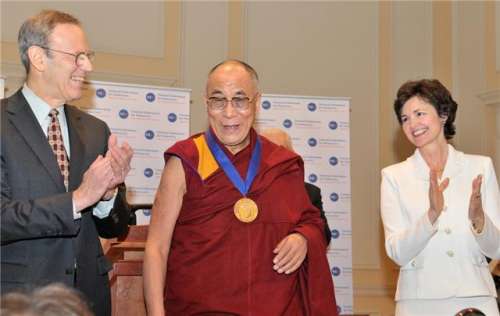
Image: Dr. Judy Shelton, now Chairperson of the NED and Trump adviser, presides over an award ceremony in 2010 for US CIA asset, the Dali Lama, a decades-long integral component of American policy to encircle, contain and divide China.

Not only do observers note continued subversive activities coordinated through local US embassies around the world since Trump's presidency began, including across Southeast Asia as part of America's continued attempts to isolate and contain China, but also movement within US agencies charged with organising and financing this subversion, such as the US State Department's National Endowment for Democracy (NED).

Recently, NED announced its new chairperson, Dr. Judy Shelton. The announcement, published on NED's website includes the following background information on Dr. Shelton:
 Dr. Judy Shelton was elected the new Chairman of the National Endowment for Democracy (NED) by NED�s Board of Directors at its January 10, 2017 meeting. An economist who has written widely on issues of international finance and monetary policy, she has also been consulted on international economic and financial issues by the Congress, the White House, and the Pentagon. Shelton previously served on the NED Board from 2005-2014, and was Vice Chairman from 2010-2014.
In other words, not only is Dr. Shelton now the new chairperson of NED, she has been directly involved with NED since at least 2005, long before, and all during NED's role in training, funding and backing the armies of regime change that swept the Middle East and North Africa (MENA) beginning in 2011. She also served on NED's board during the US-backed coup in Ukraine between 2013-2014.

Before that, between 2009-2010, NED-backed mobs took to the streets in Bangkok, Thailand in attempts to overthrow both the sitting government at the time, and also the Thai military and Thailand's head of state.

While these events have been assigned to the Obama administration for political convenience and compartmentalisation, it is actually organisations like NED that serve as the working mechanics that make such events possible.

In other words, Dr. Judy Shelton has been directly involved in NED through the entirety of America's most recent chapters of expansionism and regime change worldwide. She has also served on the board of directors for Hilton Hotels and Atlantic Coast Airlines, providing another example within NED of corporate and financial special interests driving the organisation's agenda rather than actual "democracy promotion."

An example of Dr. Shelton's activities within NED can be gleamed from a 2012 NED news letter under a headline titled, "Democracy Service Medal Presented in Cuba," in which it claims:
NED Vice-Chair Judy Shelton (second from right) presented it in person to Berta Soler, the leader of the Damas de Blanco movement founded by Laura Poll�n; H�ctor Maseda Guiti�rrez, Poll�n's widower and a journalist who spent eight years imprisoned by the Cuban government; and Laura Labrada Poll�n, Poll�n's daughter and a member of the Damas de Blanco.
Here, Dr. Shelton is directly involved in lending legitimacy to US-backed subversion in Cuba as part of a decades-long attempt to overthrow the government in Havana and expand US hegemony over the Caribbean.


Dr. Shelton also regularly oversees NED's system of self-aggrandising, the lending of legitimacy to its own members through self-awarded recognition. In 2010 in a Star Tribune article titled, "Vin Weber honored for his work with the National Endowment for Democracy," it's stated:
In Capitol Hill ceremony, Former Minnesota Congressman Vin Weber Tuesday was slated to receive the Democracy Service Medal for his work with the National Endowment for Democracy...
...Honorary co-chairs of the event are Madeleine Albright, the former Secretary of State, Richard Gephardt, the NED chair and a former Democratic leader of the House, and Judy Shelton, the NED vice chair.  
Previous award recipients include Lech Walesa, former president of Poland, the Dalai Lama, of Tibet and Francis Fukuyama, Johns Hopkins School of Advanced International Studies professor.
Vin Weber is one of several prominent, so-called Neo-Conservatives and a signatory to various pro-war letters and policy papers that preceded the conflicts waged by the United States under US presidents Bush, Obama and now continuing under Trump.

Dr. Shelton's long-time association in an organisation created specifically as a mechanism for regime change, associating with Neo-Conservatives (including not only Weber, but also the above mentioned Francis Fukuyama and Richard Gephardt) and notorious personalities like Madeline Albright who hsa repeatedly justified sanctions against Iraq that starved hundreds of thousands of children to death is particularly troubling.

The inclusion of the Dali Lama amid NED's award ceremonies, an admitted asset of the US Central Intelligence Agency, particularly during armed operations carried out by US-backed militants in Tibet against the Chinese government in the 1950s, is also telling of both the NED's work, and those that chair it, including now, Dr. Shelton.

Dr. Judy Shelton is Also A Trump Adviser 

The ice-cold bucket of water thrown onto kindled hopes that the Trump presidency will roll back "regime change" operations worldwide is the fact that Dr. Shelton is also a Trump adviser.

Fortune magazine in an interview with Dr. Shelton titled, "This Trump Economic Advisor Wants America to Go Back to the Gold Standard," would report:
Fortune reached out to Dr. Judy Shelton, one of two economists recently named to Donald Trump's economic advisory team, and the only woman to hold that title. Shelton is a senior fellow and co-director of the Atlas Sound Money Project, whose mission is to promote the principles of sound money and raise awareness of what they see as the inherent problems of our current monetary system. Dr. Shelton first rose to prominence when she predicted the economic collapse of the Soviet Union in 1989, two years before it transpired.

Whatever merits Dr. Shelton's affinity for the gold standard may or may not have in terms of ideology, her actual work, manifested in both US policy and actions has served not sound monetary policy, but the continued expansion of US corporate and financial interests as well as their domination across the planet.

It is highly unlikely that US President Donald Trump will move the United States into a gold standard, particularly with large segments of his administration run by former Goldman Sachs partners and associates (Steve Bannon, Steven Mnuchin, Gary Cohn and Anthony Scaramucci).

Dr. Shelton's role as both Trump adviser and chairperson of the National Endowment for Democracy instead, signifies a continuation, even expansion of US regime change efforts worldwide, not a withdrawal from this policy.

Nations around the world, as well as policy analysts supplying commentary and reports regarding US foreign policy, must understand that while the spokesmen in the White House might change every 4-8 years, the expansive special interests that actually determine US foreign policy do not. Dr. Shelton's involvement in NED has spanned over a decade and continues to this day, alongside many other board of director members and the interests they represent within the US defence, finance and energy industries.

Dr. Shelton's ascension both within NED and the Trump administration is yet another symptom of continuity of agenda, not the change many may still be waiting for in the coming weeks, months, and years.

Joseph Thomas is chief editor of Thailand-based geopolitical journal, The New Atlas and contributor to the online magazine �New Eastern Outlook�.

Saturday, February 25, 2017

Human Rights Watch Cites Al Qaeda and Collaborators in Latest Syria Report

February 26, 2017 (Tony Cartalucci - NEO) - On the heels of Amnesty International's admittedly and entirely fabricated report regarding Syria's Saydnaya prison, Human Rights Watch (HRW) has published its own baseless report on Syria - this one regarding alleged chlorine bomb attacks in Aleppo during the city's liberation late last year.


In a post on HRW's website titled, "Syria: Coordinated Chemical Attacks on Aleppo," it claims:
Syrian government forces conducted coordinated chemical attacks in opposition-controlled parts of Aleppo during the final month of the battle for the city, Human Rights Watch said today.
However, when qualifying HRW's accusations, it admits:
Through phone and in-person interviews with witnesses and analysis of video footage, photographs, and posts on social media, Human Rights Watch documented government helicopters dropping chlorine in residential areas on at least eight occasions between November 17 and December 13, 2016. The attacks, some of which included multiple munitions, killed at least nine civilians, including four children, and injured around 200.
Watching the videos and viewing the photographs reveals that none of them actually link any of the alleged "chlorine attacks" to Syrian forces, or even to chlorine itself.

The body of evidence presented by HRW also reveals that the interviews they conducted with alleged "witnesses" included almost exclusively opposition forces. Among them were the US-UK funded White Helmets - referred to disingenuously as "Syria Civil Defense" in HRW's report - who served as designated terrorist organization Jabhat Al Nusra auxiliaries, often found on the battlefield shoulder-to-shoulder with armed militants.

Image: "Syria Civil Defense," interviewed by Human Rights Watch, hoisting Al Qaeda's flag amid a gang of  heavily armed terrorists.

United Arab Emirate-based Al Nusra propaganda platform "Orient News" was also cited, as were other notorious anti-government propaganda networks including the Aleppo Media Center.

Not only are these clearly compromised sources of information based on their admitted political alignments, but also because of their respective, systematic fabrications throughout the Syrian conflict. It is telling of HRW's systematic bias that it would base an entire report on compromised sources drawn from the opposition, but not even a single report based on government claims.

In reality, a truly reputable rights advocacy organization would only report what physical evidence was verified. Human Rights Watch has deliberately avoided doing so not only in Syria, but amid virtually ever conflict it involves itself in.

Citing Terrorists and Verified Liars

From conflating the number of civilians "trapped" in eastern Aleppo, to attempts to downplay or dismiss the role designated terrorist organizations played in the occupation of Aleppo, the groups and individuals cited by Human Rights have practiced deliberate deceit throughout the battle for Aleppo, and the Syrian conflict at large.

For Human Rights Watch - an allegedly world-renowned rights advocacy organization - to cite such sources indicates that this latest report, like Amnesty International's recently fabricated report, constitutes a politically-motivated attack hiding behind rights advocacy, not upholding it.

Considering the timing of Amnesty International, Human Rights, and also the Atlantic Council's reports, rolled out in a multi-organizational campaign attacking the Syrian government, the individual deceit of each organization transforms into collective and coordinated impropriety.

A final consideration in the wake of Human Rights Watch's latest, politically-motivated report is the fact that all actual evidence points to the opposition itself for being behind both the production and deployment of chlorine-based weapons.

TIME Magazine in an article titled, "Syria�s Civil War: The Mystery Behind a Deadly Chemical Attack," would admit:
In August rebel forces took Sabbagh�s factory by force, as part of a sweep that also netted them an electricity station and a military airport about 30 km from Aleppo. Sabbagh, who has since fled Aleppo for Beirut, says his factory is now occupied by Jabhat al-Nusra, a militant group with strong ties to al-Qaeda that has been designated a terrorist group by the U.S. He knows this because his site manager has struck a deal with the rebels � they supply 200 L of fuel a day to keep the generator running so that the valves of his $25 million factory don�t freeze up. The factory isn�t operational anymore, but this way at least, says Sabbagh, it might be one day in the future. In the meantime, he has no idea what has happened, if anything, to the 400 or so steel barrels of chlorine gas he had stored in the compound. The yellow tanks, which hold one ton of gas each, are used for purifying municipal water supplies. �No one can know for certain, but if it turns out chlorine gas was used in the attack, then the first possibility is that it was mine. There is no other factory in Syria that can make this gas, and now it is under opposition control,� he says.
Military experts since the advent of modern chemical warfare have noted its limited utility during combat. It has very temporary tactical advantages when used on a very large scale - a scale much larger than any of the alleged attacks cited by Human Rights Watch. Strategically, a military force with superior conventional means would have no logical use for chemical weapons.


Likewise, chemical weapons would not turn the tide in the battle of Aleppo for the occupying terrorists. However, the use of chemical weapons in Aleppo and the use of the West's powerful propaganda arms to assign blame to the Syrian government did promise a very significant political and possibly strategic advantage. It was accusations of "weapons of mass destruction" that served as a pretext for war with Iraq in 2003 - a pretext the US attempted to recreate versus Syria in 2013.

With these latest, weak, and baseless accusations presented by Amnesty International, Human Rights Watch, and the Atlantic Council, we are witnessing a redux of 2013 propaganda aimed at undermining the Syrian government and expanding the West's pretext for more direct involvement in the Syrian conflict.

Tony Cartalucci, Bangkok-based geopolitical researcher and writer, especially for the online magazine �New Eastern Outlook�.   

Thursday, February 23, 2017

US War on Islamic State Designed to Fail

February 24, 2017 (Ulson Gunnar - NEO) - Any US general providing candid views on fighting and winning a war admit the impossibility of victory as long as the source of an enemy's fighting capacity remains intact.


In fact, as an excuse for why the US is still struggling in Afghanistan over a decade and a half after initially invading the Central Asian state in 2001, US General John Nicholson blamed outsiders including Pakistan, Iran and Russia for aiding, abetting and harboring anti-US forces.

No amount of military might brought to bear on forces fighting the US within Afghanistan's borders can disrupt finances, recruitment, training, weapon supplies, logistics and refitting taking place beyond Afghanistan's borders and thus beyond the US military's reach. The United States suffered a similar problem during its prolonged occupation of Vietnam. North Vietnam, China and neighboring states provided support and safe havens for fighters in the south facing off against US troops and their South Vietnamese counterparts.

Despite killing up to 4 million people and dropping more ordnance on the region than had been dropped during the entirety of World War 2, the US ultimately failed to defeat North Vietnam or prevent the reunification and independence of the Vietnamese people. 

Despite both a historical and contemporary example of futile warfare fought out of reach of the source of an enemy's fighting capacity, the US is presenting to the American public a "plan" to fight and defeat the so-called "Islamic State" in Syria completely ignoring the terrorist front's state sponsors.  

The "Plan" To Defeat the Islamic State

The plan includes a possible expansion of US troops already operating illegally and uninvited in Syria. In the Guardian's article, "US military will retain core strategy against Isis as Trump mulls escalation," it states: 
[US General Joseph] Votel, speaking from Jordan on Wednesday, said that one option to speed up a long-signaled attack on Raqqa was to �take on a larger burden ourselves�. Shouldering more of the task would mean US forces, conventional as well as special operations, bringing more artillery and logistics options to the fight.
Absent from US President Donald Trump's "plan," and from comments made by US commanders, is any mention of the source of the Islamic State's fighting capacity. No mention is made as to where they are drawing their fighters from, who is paying for and overseeing their training, arming, outfitting and continuous supplying of when finally they reach the battlefield, or how they have managed to fight the summation of Syrian, Iraqi, Iranian, Lebanese and Russian forces for years now.


Unlike in Vietnam and Afghanistan, two theaters the US desperately sought or seeks victory over indigenous resistance and had openly and repeatedly accused neighboring states of aiding and abetting that resistance, the US has been strangely quiet during both President Barack Obama's and now President Trump's administrations regarding neighboring states aiding and abetting the Islamic State.

However, without addressing the very source of the Islamic State's fighting capacity, defeating the terrorist front will be difficult if not impossible.


A Pretext for US Occupation

A plan to place large numbers of US troops in Syria, without the Syrian state's consent and amid an intentionally unwinnable, open-ended war against the Islamic State will create a pretext for the long sought after defacto US occupation of Syria. It will also give the US the ability to carve out yet another "safe haven" within Syrian territory, complimenting NATO-member Turkey's in the north.

From these two locations, terrorist forces can and will be harbored, trained, armed, supplied and sent off deep within Syrian territory to further divide and destroy the Syrian state.

Far from mere conspiracy theory, such plans have been repeatedly articulated by US policymakers since at least as early as 2012, including a Brookings Institution paper literally titled, "Assessing Options for Regime Change" (.pdf).

In it, the document clearly advocates a possible full scale US invasion and occupation of Syria, as well as the creation of what it calls "safe-havens and humanitarian corridors" that would be used not for any sort of actual humanitarian purpose but to further exert what the paper calls "coercive action."

The  paper also specifically mentions Turkey's role both in creating "safe-havens" and as serving as a base from which Syria is to be invaded and occupied.

The paper, written in 2012 under the administration of President Obama, depicts a strategy being reintroduced and expanded under US President Trump.

It represents not only a dangerous continuity of agenda, but a complete commitment by the special interests occupying Wall Street, Washington, London and Brussels to divide and destroy the Syrian state, a commitment that persists despite many setbacks.

A real "war" on the Islamic State would involve first and foremost the exposure, condemnation, isolation and destruction of its state sponsors who US intelligence and political circles have repeatedly admitted include interests within their own nation, as well as among their allies including Saudi Arabia and Qatar. Anything less indicates a rouse serving as nothing more than a pretext for an expanded US presence in Syria, not to fight and defeat the Islamic State, but to preserve it while attempting to further divide and destroy the Syrian state.

Ulson Gunnar, a New York-based geopolitical analyst and writer especially for the online magazine �New Eastern Outlook�.  

Tuesday, February 21, 2017

National Security Adviser General McMaster: The War Complex' Resident Parrot

February 22, 2017 (Tony Cartalucci - NEO) - It was recently announced that US President Donald Trump selected US Army Lieutenant General Herbert Raymond McMaster as his National Security Adviser.


The New York Times in their article, "Trump Chooses H.R. McMaster as National Security Adviser," would report:
President Trump appointed Lt. Gen. H. R. McMaster as his new national security adviser on Monday, picking a widely respected military strategist known for challenging conventional thinking and helping to turn around the Iraq war in its darkest days.
In reality, what President Trump has done, is select a man who will bring very little of his own thoughts with him to the position. Instead, he will - verbatim - repeat the talking points, reflect the agenda of, and serve the interests driving the collection of corporate-financier funded think tanks that devise - and have devised for decades - US-European foreign policy.

What General McMaster Represents

In a talk given at one such think tank, the Center for Strategic and International Studies - funded by corporations such as ExxonMobil, Hess, Chevron, and Boeing and chaired by individuals including President Trump's Secretary of State, Rex Tillerson and representatives from Lockheed Martin, Raytheon, and Betchel - General McMaster provides a well-rehearsed pitch collectively reflecting the worldview hashed out by not only the CSIS itself, but admittedly the worldview and objectives of the Brookings Institution, the Council on Foreign Relations, and a myriad of other special-interest driven policy think tanks.

The talk, published on CSIS' YouTube channel in May of 2016, features General McMaster in his military uniform accusing Russia of "invading Ukraine" and China of  "challenging US interests at the far reaches of American power." When describing China's "challenging" of US interests, he presents a map of China itself and the surrounding South China Sea - quite decidedly nowhere near the United States or any logical or legitimately proximal sphere of influence Washington could justify in maintaining.


General McMaster predicates allegations that Russia and China pose a threat to "US interest" abroad - not US national security itself - by challenging the post World War 2 international order - an order admittedly created by and for the US and its European allies, granting them military, sociopolitical, and financial unipolar hegemony over the planet.


He predictably lists North Korea and Iran as threats to the US as well, despite neither nation attacking the US nor possessing a desire or capability to do so. He accuses Iran in particular of "fighting a proxy war against us since 1979," referring to when Iranians finally, successfully overthrew the US-installed and buttressed brutal dictatorship of Mohammad Reza Shah Pahlavi in 1979.

General McMaster accuses Iran of "building militias" beyond the control of Middle Eastern governments to both support them but also to use as leverage against them - not unlike what the US has done both through occupation forces deployed across the region and state sponsored terror groups armed, funded, trained, and directed by the US and its Persian Gulf allies everywhere from North Africa to the Middle Eastern nations of Iraq, Yemen, Syria, and Lebanon.  

During his 2016, McMaster then moved on to address the self-proclaimed "Islamic State" (ISIS). He presents a slide of ISIS' territorial holdings clearly depicting supply lines running directly out of NATO-member Turkey, leading deep into Syria and Iraq, with a lesser line emanating out of US-ally Jordan. He makes no mention of the source of ISIS' fighting capacity, depicting the conflict in the similarly cartoonish manner US-European media presents it to the general public.

General McMaster presents to his audience a defense strategy based on "deterrence by denial, and deterrence at the frontier to ratchet up the cost [for] potential adversaries at the frontier," referring to regions of the planet thousands of miles from US shores where the US seeks to either maintain or reassert it power and influence, or to project its power into regions hitherto independent of Wall Street and Washington's influence.

Seamless Continuity of Agenda 

President Trump's pick of General McMaster as National Security Adviser ensures that national security remains dominated by the corporate-financier funded think tanks that have devised, determined, and dominated US foreign policy for decades. Policy papers General McMaster repeatedly cites in every talk he gives, at one corporate-financier funded think tank after another, are the products of these very think tanks.

That General McMaster identifies Russia, China, and Iran as "threats" to the United States, not because they seek to harm the US within its territory or within any logical proximal sphere of influence, but simply for attempting to secure their own respective proximal spheres of influence from systematic and overt US subversion, influence, and encirclement, means a continuation of the destructive global spanning warfare seen under the administrations of numerous other presidents, including Presidents Obama, Bush, Clinton, Bush Sr. Reagan, and even Carter.

While the United States poses as a "democratic" nation, driven by the interests of its people, it is apparent that special interests on Wall Street and in Washington have a singular agenda that transcends both the presidents the people "elect," and the policies they believe they elected these presidents to carry out. That President Trump's supporters labor under the delusion that he will roll back US aggression and regime change worldwide, only to put in place General McMaster as his National Security Adviser - a man who openly and repeatedly supports the pursuit of American global hegemony - indicates that yet again the people have been deceived and that this singular agenda will move forward unabated.

Tony Cartalucci, Bangkok-based geopolitical researcher and writer, especially for the online magazine �New Eastern Outlook�.  

Monday, February 20, 2017

Continuity of Agenda: Destroying Syria, Since 1983

February 21, 2017 (Tony Cartalucci - NEO) - Syria's current conflict, beginning in 2011, was the culmination of decades of effort by the United States to subvert and overthrow the government in Damascus. From training leaders of opposition fronts years before "spontaneous" protests erupted across Syria, to covertly building a multinational mercenary force to both trigger and leverage violence thereafter, the United States engineered, executed, and perpetuated virtually every aspect of Syria's destructive conflict.


Enlisting or coercing aid from regional allies, including Saudi Arabia, Qatar, the United Arab Emirates, Turkey, Jordan, and Israel, Syria found itself surrounded at its borders and buried within them by chaos.

"Bringing Real Muscle to Bear Against Syria" 

But recently revealed CIA documents drawn from the US National Archives portrays recent efforts to undermine and overthrow the Syrian government and the Syrian conflict's relationship with neighboring Lebanon and its ally Iran as merely the most recent leg in a decades-long campaign to destabilize and overturn regional governments obstructing US interests.

A 1983 document signed by former CIA officer Graham Fuller titled, "Bringing Real Muscle to Bear Against Syria" (PDF), states (their emphasis):
Syria at present has a hammerlock on US interests both in Lebanon and in the Gulf -- through closure of Iraq's pipeline thereby threatening Iraqi internationalization of the [Iran-Iraq] war. The US should consider sharply escalating the pressures against Assad [Sr.] through covertly orchestrating simultaneous military threats against Syria from three border states hostile to Syria: Iraq, Israel and Turkey. 
The report also states:
If Israel were to increase tensions against Syria simultaneously with an Iraqi initiative, the pressures on Assad would escalate rapidly. A Turkish move would psychologically press him further. 
The document exposes both then and now, the amount of influence the US exerts across the Middle East and North Africa. It also undermines the perceived agency of states including Israel and NATO-member Turkey, revealing their subordination to US interests and that actions taken by these states are often done on behalf of Wall Street and Washington rather than on behalf of their own national interests.


Also mentioned in the document are a variety of manufactured pretexts listed to justify a unilateral military strike on northern Syria by Turkey. The  document explains:

Turkey has considered undertaking a unilateral military strike against terrorist camps in northern Syria and would not hesitate from using menacing diplomatic language against Syria on these issues.   
Comparing this signed and dated 1983 US CIA document to more recent US policy papers reveals a very overt continuity of agenda.


Decades-Spanning Continuity of Agenda 

The corporate-financier funded policy think tank, Brookings Institution, published a 2012 document titled, "Saving Syria: Assessing Options for Regime Change" (PDF), which stated:
Some voices in Washington and Jerusalem are exploring whether Israel could contribute to coercing Syrian elites to remove Asad. 
The report continues by explaining:
Israel could posture forces on or near the Golan Heights and, in so doing, might divert regime forces from suppressing the opposition. This posture may conjure fears in the Asad regime of a multi-front war, particularly if Turkey is willing to do the same on its border and if the Syrian opposition is being fed a steady diet of arms and training. Such a mobilization could perhaps persuade Syria�s military leadership to oust Asad in order to preserve itself. 
Just as the CIA sought to covertly apply pressure on Syria via Iraq, Israel, and Turkey in 1983, it seeks to do so today. Instead of to simply reopen a pipeline perceived as vital to the Iraqi war effort vis-a-vis Iran in the 1980s, the goal now is regime change altogether.

It should be noted that, in addition to the 1983 CIA document, US support for violent subversion in Syria during the 1980-1988 Iran-Iraq War also included the 1982 Muslim Brotherhood uprising and its subsequent defeat by Syrian forces within Syria - an almost verbatim analogue to the 2011 unrest that led to the current Syrian conflict - also organized and carried out by US-backed elements of the Muslim Brotherhood.

It should also be noted that while the 2011 conflict in Syria began under the administration of US President Barack Obama - according to Pulitzer Prize-winning journalist Seymour Hersh's article, "The Redirection: Is the Administration�s new policy benefitting our enemies in the war on terrorism?" - planning, training, and staging began at least as early as 2007 under the administration of US President George Bush.

A concerted, continuous conspiracy to manipulate events across the Middle East and North Africa and project American hegemony throughout the region spanning now seven US presidencies is perhaps the most telling evidence that deeply rooted special interests - a deep state - not America's elected representatives, crafts and executes US policy at home and abroad.

Power is Held by Unelected Special Interests, Not Elected Representatives 

The notion that the recently elected US president, Donald Trump, can, is willing to, or is able to suddenly oppose the immense corporate-financier interests driving a concerted conspiracy spanning three decades lacks any basis in fact. In reality, those who President Trump surrounded himself with both during his campaign for the presidency and upon assembling his cabinet, are among the very conspirators behind this decades-long agenda.

For those who find themselves targets of US subversion and aggression, both overt and covert, understanding the deep state and the corporate-financier interests that comprise it driving these agendas is essential. Devising a means to expose, isolate, and otherwise disrupt the unwarranted power and influence they wield - rather than dealing with their political proxies in Washington - is the only way to balance the currently lopsided equation of global power.


For the American people and citizens of nations beholden to American interests, understanding that change will only come when the corporate-financier interests that constitute the deep state are confronted and decentralized, and not through elections involving proxies wholly beholden to the deep state, will be the first step toward taking back national institutions and resources hijacked by these special interests.

Tony Cartalucci, Bangkok-based geopolitical researcher and writer, especially for the online magazine �New Eastern Outlook�.