Showing posts with label philippines. Show all posts

Wednesday, November 16, 2016

US Feigns Human Rights Concerns in Philippines

US once invaded, mass murdered, and terrorized the population of the Philippines, on a scale vastly dwarfing Duterte's "war on drugs." 

November 16, 2016 (Tony Cartalucci - NEO) - Philippine President Rodrigo Duterte is heading a controversial campaign against crime, embodied in his "war on drugs" which has led to violence spanning the nation's troubled urban centers. President Duterte's comments have ranged from reasonable, to utterly indifferent regarding fears of extrajudicial executions, vigilantism, and very real human rights abuses - opening a door of opportunity for his political opponents both at home and abroad.

President Duterte's inability to clearly condemn extrajudicial executions and vigilante violence, along with his inflammatory, provocative, even dangerously demagogic statements both invites further abuses, as well as both legitimate and opportunistic criticism of him, his administration, and his policies.

While legitimate criticism is both necessary and justified, it is undermined by disingenuous political opportunism, wielded by hypocrites who only stand to compound the Philippines' current crisis, not solve it.

America the Humane? 

Among President Duterte's more opportunistic political opponents is the United States.

While the United States would otherwise be justified and morally grounded in its criticism of President Duterte's administration, there are some current and past complications that reveal such criticism as stark hypocrisy, crass opportunism, and even the cynical political exploitation of abuse, rather than any genuine attempt to constructively address or stop it.

The most recent manifestation of America's feigned concern regarding the Philippines' ongoing campaign against accused illicit narcotic dealers was the blocking of a shipment of US-made rifles destined for Philippine police units. Some 26,000 rifles were on order before being blocked by the US Senate based on "concerns about human rights violations."


These concerns, however, have not prevented the US from selling billions of dollars worth of weapons, including warplanes, munitions, tanks, and helicopters to Saudi Arabia, who is using this vast US-made arsenal to oppress its own people and execute a war of aggression against neighboring Yemen. Saudi Arabia is also admittedly involved in arming and funding terrorist organizations in Syria and Iraq, including with US-made weapons - particularly anti-tank TOW missiles.

This hypocrisy exposes US "concerns" as merely politically motivated, designed to put pressure on Manila in an effort to reassert US influence over the Southeast Asian state. Not only has the US previously enjoyed greater influence over the Philippines since the end of World War II, but before the war, and for half a century, the United States literally controlled the Philippines as a US territory.

It seized the Philippines in a bloody 1899-1902 war that claimed the lives of over a quarter of a million people (some sources estimate over half a million), and initiated an occupation marked by brutality, oppression, and torture, including the introduction of water boarding (then called "water curing") conducted by the US as a means of attitude adjustment for local Philippine leaders.

Image: US occupiers "water curing" the Philippine population. Today, this practice is known as "water boarding" and is still carried out by US military and intelligence agencies during interrogations even today.

It is ironic and telling that both water boarding and attempts by the US to maintain influence over the Philippines both persist to this day. Attempts by the US to predicate its desire to control Manila on "concerns about human rights violations" not only is bitterly ironic, it undermines those genuinely attempting to expose and stop real abuses taking place amid the Philippines' current crisis.

President Duterte has been able to insulate himself from criticism precisely because of US hypocrisy and meddling. Had independent, local activists and media platforms - networked with regional and international organizations - attempted to expose and rein in President Duterte's anti-crime campaign, it would have been immeasurably more difficult to dismiss the facts and continue with impunity.

The US has in essence discredited genuine human rights concerns by hijacking them for self-serving political objectives.

Extrajudicial executions, vigilante violence, and President Duterte's indifference, even defense of both, needs to be opposed - but by the people of the Philippines - not disingenuous, exploitative, and self-serving foreign interests who are not only notorious human rights abusers today - worldwide - but who have carried out campaigns of extermination, torture, and human rights abuses in the Philippines itself, as a foreign conqueror and occupier.

For President Duterte, it is more than possible for him to lead a more dignified and just campaign against criminals operating across the Philippines. Nations like Singapore have used stern, popular, but legitimate judicial measures to rein in the drug trade and organized crime, so can the Philippines. Doing so would close this door of opportunity President Duterte himself opened to the Americans, and leaves open with his current policies.

Tony Cartalucci, Bangkok-based geopolitical researcher and writer, especially for the online magazine New Eastern Outlook.� 

Thursday, November 10, 2016

Politics Over Principles: US Denies Philippines Weapons, Continues Arming Saudis

November 10, 2016 (Ulson Gunnar - NEO) - Perhaps the biggest challenge the US faces regarding its credibility globally is the self-inflicted damage it does to its alleged principles and values as a center of global power.


A perfect example of this is unfolding in the dramatic unraveling of US-Philippine relations where any and every means of finding leverage over Washington's wayward ally is being brought to bear on Manila.

The most recent manifestation of this occurred when the US blocked the shipment of US rifles destined for the Philippines' police forces. PhilStar Global's article, "Duterte cancels rifle sale blocked by US over rights concerns," would report that:
The US State Department had earlier halted the sale of about 26,000 rifles to the Philippines when US Sen. Ben Cardin said that he will oppose it due to concerns over human right violations attributed to the government's war on drugs.
At face value, and ignoring any wider context, it would appear that the United States took a moral stand on what would have otherwise been a lucrative arms deal and would have helped draw Washington and Manila closer together politically.

However, zooming out slightly from Manila, the situation in Asia Pacific finds the US being incrementally pushed out of the region as a geopolitical power broker. As nations, including the Philippines rebuff the United States and its attempts to reassert itself vis-�-vis China, Washington has resorted to leveraging human rights issues, economic pressure and even covert political and military pressure to maintain its grip on each respective nation in the region.

Putting pressure on Manila through a humiliating political stunt, not adhering to moral convictions, is the primary factor driving Washington's decision to block its own delivery of weapons to the Philippines' police forces.

And beyond simply identifying the true motive of America's recent stunt, there is the matter of overt hypocrisy to account for.

Philippines Denied Rifles, Saudis Given Tanks, Warplanes and Bombs 

While the US poses as morally bound to block its weapons deal with the Philippines, it continues to supply the nation of Saudi Arabia with billions of dollars of advanced weaponry, including air-delivered munitions, warplanes and main battle tanks.


In fact, according to the Guardian, in 2010 the US approved of a record weapons deal amounting to $60 billion, the largest such deal in US history. It included the delivery of additional F-15 fighters, Apache gunships and Black Hawk transport helicopters, many of the weapons now being used in armed aggression against neighboring Yemen.

The war in Yemen prosecuted by Riyadh with US and European weaponry, has become a growing humanitarian disaster with even the US and Europe's own human rights advocacy groups forced to acknowledge the growing abuses being carried out by America and Europe's close Arab ally.

And just this year, Reuters would report that the US Senate approved of an additional $1.15 billion arms deal with Saudi Arabia for the delivery of over 130 M1 Abram main battle tanks as well as 20 armored recovery vehicles and addition equipment to support the newly acquired systems.


Absent amid these immense weapon deals with Saudi Arabia, noted globally as a dictatorship, guilty of brutalizing its own people including through the use of public beheadings and torture, was any semblance of hesitation based on moral convictions.

Indeed, the torrent of weapons the United States supplies the Saudis, in the face of a recent block on rifle sales to the Philippines, proves the United States places politics over principles. Special interests in Washington use such principles merely as a politically-convenient prop when the opportunity presents itself, and otherwise views such principles as a surmountable obstacle to be effortlessly skipped over.

A United States guided by true convictions would be arming neither nation. A United States that sees convictions as politically convenient gimmicks, easily denies the Philippines rifles based on selective moral outrage while propping up a regime on the Arabian Peninsula that is brutalizing its people at home, prosecuting a devastating war in a neighboring nation and sponsoring terrorism worldwide.

It is this lack of genuine, consistent moral principles that undermines the United States' own self-declared status as a global leader, undermining its credibility along with the faith both Americans and foreigners alike have in the waning superpower.

Ulson Gunnar, a New York-based geopolitical analyst and writer especially for the online magazine �New Eastern Outlook�.

Saturday, October 29, 2016

What the Philippines Says Vs. What it Does

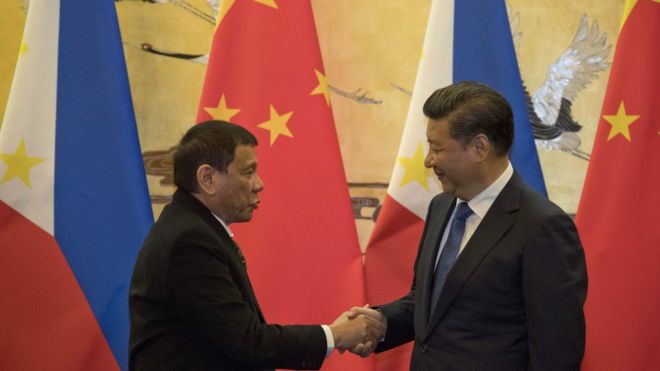
October 30, 2016 (Joseph Thomas - NEO) - Philippines President Rodrigo Duterte has been identified as a menace to US foreign policy in Asia Pacific by both his supporters and his opponents. For his supporters, he is propped up as a hero of "anti-imperialism," while his detractors claim his leadership incites instability, is nonconstructive and is leading his Southeast Asian state to ruin.


The truth, however, exists somewhere in between.

A look at the Philippines within Southeast Asia reveals a nation that has long existed within America's geopolitical and economic sphere, but also a nation more recently emerging from that sphere, pulled into the political and economic orbit of Beijing and in a wider sense, an increasingly influential and growing Asia.

The Philippines eventually replacing its various, compromsing dependencies on Washington is inevitable. Whether or not President Duterte's recent rhetoric is proportional to the Philippines' actual ability to replace these dependencies in the immediate and sweeping manner he has suggested is another matter entirely.

The necessity to compromise the Philippines' sovereignty and independence in exchange for economic ties with the United States clearly is no longer in Manila's best interests. Its trade with China and other Asian states far outweighs its trade with the United States.


Exports from the Philippines, for example, primarily remain in Asia, nearly two-thirds in fact. Exports to the US account for only about one-sixth of the Philippines' exports. This is not insignificant, but it is clearly disproportionate to the political and economic influence the US seeks to wield both in Asia and in the Philippines specifically.


Nor is the need to continue depending on the United States to "underwrite" the Philippines' security in the region necessary, especially since such "underwriting" generally involves protecting Manila from confrontations Washington itself intentionally provokes with the Philippines' neighbours, including China. No clearer example of this can be seen than the recent Philippines-China row in the South China Sea, where the United States itself assembled a team of American and British lawyers to represent Manila in what it called an "international tribunal" which predictably ruled against Beijing in Manila's favour.

The tribunal sought to inflame the confrontation, and bring it from a simple bilateral issue, to an increasingly serious international confrontation meant to isolate Beijing.

What the Philippines is Actually Doing... 

President Duterte's rhetoric has been extreme, however the steps the Philippines is actually taking have been much more measured and proportional.

In regards to trade, the Philippines is on a natural trajectory to continue closing in with Beijing and the rest of Asia. Militarily, it also benefits the Philippines to incrementally remove US troops from its territory, scale back joint exercises, particularly those intentionally carried out to provoke Manila's neighbours as well as seek new sources for cheaper and more reliable military hardware.


In terms of America's showpiece conflict in the South China Sea, the Philippines has already distanced itself from Washington's strategy of confrontation, encirclement and isolation in regards to Beijing and has instead attempted to resolve the issue bilaterally with Beijing itself. The expensive and time-consuming "tribunal" the United States organised for the Philippines has all but been thrown to the wayside as a result of this.

The Philippines' shifting ties in Asia Pacific are more a matter of practicality than ideology. If practical matters dictate that the Philippines maintains some ties to the United States, it will do so. This is because despite shifting closer to Asia in general, the Philippines still has many economic and political ties to Washington that will be difficult to simply "cut" in the short-term. In the long-term, practical alternatives need to be created and incrementally implemented.

There is also a large number of Philippine political and business leaders who have no interest in severing ties with the United States, ties they directly benefit from and ties that they do not see alternatives to with a Philippine pivot toward Beijing and the rest of Asia.

This political and economic bloc, however small, will receive increased support from the US to place pressure on Manila to slow down or even reverse its shifting ties. This can already be seen across various media platforms in and beyond the Philippines, as well as within the government itself.

Patience and Pragmatism 

President Duterte's rhetoric is meant to stir up public support more than actually signal his nation's real intentions. Other nations throughout Asia are also pursuing a "pivot" away from the United States and its attempts to reassert itself in Asia Pacific. However, they are doing it quietly, incrementally and are attempting to make whatever concessions they must with Washington to stave off large-scale, concerted attempts to destabilise or even overturn political order in each respective nation.

The Philippines has a long journey ahead of itself in establishing a more independent and self-sustaining nation state. It faces not only countervailing forces it must navigate amid Beijing and Washington's ongoing jockeying for regional power and influence, but also internal challenges to overcome.

Should President Duterte place increased substance behind his extreme, often shifting rhetoric, and change tack toward more pragmatic and consistent policies, he may be able to enjoy the best of both worlds, popular support, and improved leverage for his nation amid a tumultuous time.

Joseph Thomas is chief editor of Thailand-based geopolitical journal, The New Atlas and contributor to the online magazine �New Eastern Outlook�.

Monday, September 5, 2016

US-Philippines Row Widens: Philippines Reminds US it is a Sovereign Nation

September 6, 2016 (The New Atlas) - Philippine President Rodrigo Duterte was prompted to remind the United States that the Philippines is a sovereign nation after the US announced its intentions to lecture him regarding his handling of crime in an upcoming meeting that has since been cancelled by the US. 


CNN's article, "After cursing Obama, Duterte expresses regret," would report that:
White House officials previously said Obama would confront Duterte about his country's handling of drug dealers, including extrajudicial killings, which are government executions without the benefit of judicial proceedings. 

"Who does he think he is? I am no American puppet. I am the president of a sovereign country and I am not answerable to anyone except the Filipino people," Duterte scoffed in a speech Monday. "Son of a bitch, I will swear at you."
It is the latest in a series of recent incidents that have marked a widening row between Washington and its former colonial territory of the Philippines, afforded "independence" only as recently as 1946 and having seen an ebb and flow of coercive US influence and military presence on the island nation in the decades since.

Since President Duterte came to power, US plans to use the Philippines as a proxy in a growing conflict with China have been derailed.


A US-led "international tribunal" regarding China's claims in the South China Sea, allegedly heard on behalf of the Philippines, was rejected not only by Beijing, but received little enthusiasm even in the Philippines itself. The Philippines and the majority of ASEAN refused to use strong language in a joint regional statement regarding the South China Sea dispute, rendering American efforts to escalate the conflict impotent.


In mid August 2016, President Duterte condemned US Ambassador Philip Goldberg as meddling and lacking resolve for having involved himself in discussions regarding campaign debates ahead of elections that saw Duterte brought into power.

US Concerns Over Human Rights Beg Belief 
CNN's article and the White House itself attempts to convince the public that US concerns regarding the Philippines and any pressure perceived to be placed on Manila revolve around "human rights" and more specifically, around the subject of "extrajudicial killings." CNN reminds readers such killings are "executions without the benefit of judicial proceedings."


Yet the public, particularly in Asia and in the nation of the Philippines itself, may sense a lack of sincerity regarding these concerns. This is mainly because the United States itself has been conducting a global campaign of extrajudicial killings, particularly in Afghanistan and Pakistan, as well as in North Africa and the southern Arabian Peninsula in regards to years of drone strikes on "suspected terrorists," or in other words, "executions without the benefit of judicial proceedings."

Also in regards to human rights, the US' intentional deception to justify the invasion and occupation of Iraq in 2003 has cost tens of thousands of people their lives, displaced or otherwise disrupted the lives of millions more and has left not only Iraq in ruins, but the entire region in perpetual conflict since.


There is also the matter of systemic torture employed by the US military and intelligence agencies both in Iraq and other theatres of operation, as well as in facilities scattered around the globe maintained specifically for the detainment and torture of suspects denied "judicial proceedings."

Also worth considering is the United States' geopolitical and military relationship with Saudi Arabia, a renowned state-sponsor of terrorism, a regional aggressor currently devastating neighbouring Yemen with an inexhaustible supply of US and European weaponry and a world leader in human rights abuses which include a judicial system and public beheadings that appear to have been the very inspiration for the notorious terrorist organisation, the Islamic State.

In this context, President Duterte's comments, however undiplomatic, are not entirely unjustified. While the matter of extrajudicial killings in the Philippines is certainly a serious concern, it is clearly not a genuine concern for the US who has committed itself to its own systematic and global violation of human rights on a scale dwarfing that of the Philippines' recent crackdown.

US "Concerns" a Pretext for Coercing Region into Confrontation with China

The United States is clearly, cynically using the crackdown as a pretext to apply pressure on the Philippines in order to exact concessions regarding other matters, especially in regards to Washington's desire to expand the conflict in the South China Sea using the Philippines as a proxy to do so.

Conflict with China in no way benefits the Philippines or the rest of Asia. Asian states find within the region the majority of their economic trade and development, with China, not the United States, serving as the fulcrum upon which economic prosperity pivots upward. Disrupting stability in the region will collectively weaken Asian states, allowing the United States to reassert its gradually waning "primacy" in the region.


Quite clearly, no Asian state will voluntarily capitulate to American designs aimed at provoking conflict, destabilising the region and costing Asia collective economic and geopolitical progress simply to allow a foreign power to reassert itself regionally.

Thus, the US seeks various means, generally feigned concern regarding "democracy" and "human rights," to pressure respective nations back into line. Failing that, increasingly confrontational tactics are employed, including US support of subversive, even violent political opposition groups, economic sanctions and even terrorism. The latter of these tactics will likely be visited upon the Philippines for its latest and most dramatic act of defiance yet, both more frequently and on a greater scale through the use of terrorists sponsored by the above-mentioned US ally, Saudi Arabia.

Asia's progress depends on collective stability, and to maintain that stability requires a collective response to coercion by foreign powers, particularly the United States and Europe. In decades and centuries past the West has succeeded in dividing nations within and against one another to divide and rule over entire regions of the planet. Today, there stands an opportunity for Asia, particularly ASEAN, to balance the region internally to discourage regional players from coercing or interfering in another's affairs, and protect the region collectively from coercive threats from abroad.

 The New Atlas is a media platform providing geopolitical analysis and op-eds. Follow us on Facebook and Twitter.

Saturday, August 27, 2016

US "International Court" Ruling on China Falls Short

The Philippines needs a stable Asia to prosper, not regional militarization, and certainly not a confrontation with China.

August 27, 2016 (Tony Cartalucci - NEO) - A recent "international tribunal" ruling regarding China's claims in the South China Sea was more than just anticlimactic - it was indicative of the United States' waning influence as well as the waning legitimacy of the many international institutions it has used, abused, and thus undermined for decades.


The New York Times in an article titled, "Tribunal Rejects Beijing�s Claims in South China Sea," would claim:
An international tribunal in The Hague delivered a sweeping rebuke on Tuesday of China�s behavior in the South China Sea, including its construction of artificial islands, and found that its expansive claim to sovereignty over the waters had no legal basis. 
The landmark case, brought by the Philippines, was seen as an important crossroads in China�s rise as a global power and in its rivalry with the United States, and it could force Beijing to reconsider its assertive tactics in the region or risk being labeled an international outlaw. It was the first time the Chinese government had been summoned before the international justice system.
Despite the NYT's claims that the case was "brought by the Philippines," it was in fact headed by an American lawyer, Paul S. Reichler, of US-based law firm, Foley Hoag. Just like the court case itself, the apparent conflict in the South China Sea may be portrayed as being between China and its neighbors, but it is in reality a conflict cultivated by the US explicitly as a means of maintaining "primacy in Asia."

Image: Paul Reichler, an American, not a Filipino, and his American-British legal team represented the Philippines in an international court case that solely benefited the US. 
Facing Threats to "US Primacy in Asia"

The corporate-financier funded and directed policy think tank, the Council on Foreign Relations (CFR) published a paper titled, "Revising U.S. Grand Strategy Toward China," penned by Robert Blackwill - a Bush-era administrator and lobbyist who has directly participated in Washington's attempts to maintain hegemony over Asia.

Blackwill's paper states clearly what interests the US has in Asia (emphasis added):
Because the American effort to 'integrate' China into the liberal international order has now generated new threats to U.S. primacy in Asia�and could result in a consequential challenge to American power globally�Washington needs a new grand strategy toward China that centers on balancing the rise of Chinese power rather than continuing to assist its ascendancy.
The CFR paper constitutes a US policymaker openly admitting that the US perceives itself as possessing and seeking to maintain "primacy in Asia," primacy being defined by Merriam-Webster as, "the state of being most important or strongest."
The notion that the United States, from an entire ocean away from Asia, should proclaim itself "the most important or strongest" nation in Asia is in itself every bit in reality a threat to intentional peace and stability as the US claims Chinese primacy in Asia would be. 

The South China Sea "Conflict" as a Pretext

More specifically, Blackwill would mention the South China Sea conflict as the primary pretext with which to further tighten American control over an Asia the paper admits is slipping away.

The paper then enumerates a list of self-serving measures the US should take predicated on the alleged conflict, which include:
  • Defense reform within the Armed Forces of the Philippines to develop a full range of defense capabilities that would enable the government to deter and prevent intrusions on or possible invasion of Philippine territory;
  • Boost Indonesia�s role in joint exercises and expand its scope, symbolically indicative of Jakarta�s growing centrality to security in the Asia Pacific, and gear military aid, training, and joint exercises with Indonesia toward air-sea capabilities; 
  • Help Singapore upgrade its current air force capabilities from F-16s to F-35s;
  • encourage Malaysia to fully participate in the Proliferation Security Initiative, which it agreed to join in April 2014, and promote more active Malaysian involvement in combined exercises, domain awareness architectures, and the like; 
  • Seek to expand the scope of activities during the annual U.S.-Vietnam naval exercises to include joint humanitarian assistance and disaster relief, and/or search and rescue exercises, and make more frequent stops at the port at Cam Ranh Bay in the short term; 
  • Establish strategic International Military Exchange Training (IMET) programs with Myanmar, with a focus on professionalizing the military, and continue to integrate the Myanmar military into, and 
  • Expand its participation in, joint international military exercises;  
  • Advocate substantial IMET expansion throughout Southeast Asia; 
  • Help build domestic democratic political capacity throughout the region. 
It is clear that this sweeping military expansion the US proposes not only lends to the United States unwarranted influence over the military forces, governments, and very sovereignty of each respective Southeast Asian state, but includes the transparently self-serving requirement of purchasing immense amount of US weapons to threaten China with. In fact, Blackwill openly suggests Singapore's F-16s be upgraded to the scandal-ridden, grossly overpriced F-35.


The paper, 70 pages in total, expounds in immense detail this, the latest chapter in Washington's decades-long effort to encircle and contain China. 

It is clear then why the US took the Philippines by the hand to the Hague for its court case against China.

An International Tribunal Not Internationally Recognized 

While the US media attempted to stampede public opinion with the supposed gravity of the tribunal's decision, it was met by silence worldwide. 

China outright rejected the entire proceeding before the ruling was even read, while other nations in Southeast Asia have continued drawing closer still in economic, political, and military cooperation with China.

Thailand, the second largest economy in Southeast Asia's ASEAN bloc, has recently announced its intentions to buy up to 100 VT-4 main battle tanks from China and has continued exploring the possibility of purchasing several Chinese-made diesel electric submarines. Many of the trains now running in Thailand are Chinese-made as will be new rail lines built across the country. Thailand has also begun conducting joint-military exercises with China to rebalance its fading relationship with the United States. 

Thailand, along with other Southeast Asian nations have insisted that they have no stake in the South China Sea dispute, and have refused categorically to take sides in it despite pressure from each nation's respective US ambassador. Beyond Asia, Europe too has refused to intervene, and failed to decisively recognize the tribunal's recent ruling. 


Reuters in its article, "Discord over South China Sea clouds Asia-Europe summit," would report that:
A key summit between Asian and European leaders in Mongolia ended on Saturday without direct mention of the South China Sea dispute in its closing statement, with diplomats describing intense discord over the issue between Europe and Asia.
It would also add that:
On Friday, the European Union issued a statement noting China's legal defeat but avoided direct reference to Beijing, reflecting discord among EU governments over how strongly to respond to the court ruling.
One must wonder then, just how "international" a tribunal is, whose ruling is not recognized internationally. 

International Tribunal Serves US, Not Philippine Interests 

Even in the Philippines, whose name the case was brought to the tribunal in, reactions were muted, with the newly elected president, Rodrigo Duterte, calling for calm in the aftermath of the ruling. The Financial Times in its article, "Duterte calls for calm as SE Asia grapples with sea ruling," would state:
[President Duterte's] call for peaceful talks instead, echoed across Southeast Asia, highlights the region�s difficult position following this week�s international tribunal ruling at The Hague. Several countries in the 10-member Association of Southeast Asian Nations have territorial quarrels with Beijing, but none want to spark an unwinnable war or alienate a superpower to which they are tied by aid, trade or cultural affinities.
In other words, the ruling and the expected confrontation the US had hoped to spark, benefits Southeast Asia in no shape, form, or way and despite the considerable influence the United States still holds over the Philippines, it is apparent that the will for peace, prosperity, and progress is more considerable still. 


Indeed, according to Harvard University's Atlas of Economic Complexity, the Philippines' leading trade partner is China, with 26% of its exports and 19% of its imports accounted for amid the two nations' economic ties. The United States on the other hand, accounts for only 12% of the Philippines exports, and 9% of all imports. It is upon Asia, by far, that the Philippines economy depends - an Asia enjoying peace and stability. And it is this peace and stability that is directly threatened by America's openly declared plan to militarize the region and confront China.

It is clear that America's closest allies in the region are disinterested in confronting China, and while the US emphasizes the need to confront Chinese "coercion," it is clear that the United States has resorted to coercion itself to punish nations unwilling to help it uphold its "primacy in Asia."

While the US is sure to resort to an array of punitive measures against the Philippines, as well as the rest of Southeast Asia for failing to enable its "primacy in Asia," one thing is certain. An "international tribunal" the entire world fails to recognize is no longer "international." The irrelevance of the US-backed tribunal is a harbinger of what's to come for the "international order" itself that the US poses as head of.

One only hopes that China has paid careful attention to the brutal, bloody, and shameful spread of American hegemony, and its now ignominious retreat - and decides to take another path on its way toward global power - one that bypasses aspirations for global hegemony, and one that instead arrives at leading by example. For Southeast Asia's part, ensuring their economies, societies, and armed forces remain strong and vigilant, can help guide China toward that destination peacefully and without temptation.  
  
Tony Cartalucci, Bangkok-based geopolitical researcher and writer, especially for the online magazine New Eastern Outlook�.